
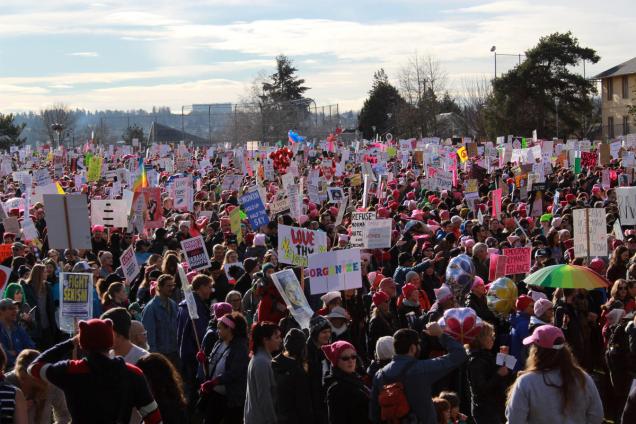
 Photography by Caitlin Swamy (January 21, 2017, Seattle, WA)
There are three major divides that exist within the world today: the ecological divide, the social divide, and the spiritual-cultural divide (Scharmer & Kaufer, 2013, p. 4). Each of these divides are evident in the human experience, highlighting our interdependence as humanity. The ecological divide speaks to the global depletion of natural resources. We are currently operating in a system that uses fifty percent more resources than our planet can regenerate to meet our consumption needs (Scharmer & Kaufer, 2013, p. 4). The social divide highlights the increasing polarization of collective wealth worldwide. Two and a half billion people live on less than $2USD per day, and yet the top 1 percent still holds a greater collective worth than the bottom 90 percent (Scharmer & Kaufer, 2013, p. 4). The ecological and social divides are disconnects between individuals and the outside world: nature and other human beings. The third divide known as the spiritual-cultural divide highlights the gap between our current reality and our emerging future “Self.” The emerging “Self” represents one’s greatest potential as a human being, free of judgment, cynicism, and fear. There are three voices that exist within each human being: the voice of judgment, the voice of cynicism, and the voice of fear. These voices highlight the gap between current reality the emerging future “Self.” The voice of judgment limits our ability to open our mind. We download instead of inquire. The voice of cynicism makes us close our hearts to others. We disconnect instead of relating. The voice of fear, and one that is most prevalent within many of us today, shuts down our ability to open our will. We hold onto the past or the present instead of letting go. Scharmer & Kaufer (2013) write, “Bridging the gap between eco-system reality and ego-system awareness is the main challenge of leadership today” (p. 12). Currently, we continue to collectively produce results that no one wants.
Palmer (1997) writes, “Movements represent the principle of flux and change: they are the processes through which a society channels its energies for renewal and transformation” (p. 164). Now, more than ever, there is a call for Servant leaders. Our world leaders are making decisions that are increasing the ecological and social gaps in society. As a Servant leader, I am concerned about the current state of the leadership in the world. We are being fed propaganda that evokes hatred and an “us versus them” mentality. Where we should be celebrating one another’s diversity, many are choosing fear over hope. Desmond Tutu believed that retribution would result only in widespread violence and advocated for forgiveness, empathetic listening and understanding. Atrocities, violence, and conflict in all its forms will continue to be a dynamic part of our existence. I’m willing to bet that the likelihood for healing and justice is much greater when we choose compassion and engage with one another through dialogue. What makes this approach possible? I believe it is the moral imagination that exists within each of us.
Lederach (2005) writes, “What makes change possible… What creates a moment, a turning point, of such significance that it shifts whole aspects of a violent, protracted setting of conflict? I believe it is the serendipitous appearance of the moral imagination in human affairs” (p. 19). One’s moral imagination is the primary factor contributing to an understanding of the world and a sense of purpose in being part of it (Fennell, 2016). The moral imagination plays a critical role in conflict transformation. Lederach (2003) writes, “I see our human community… is on the edge of historical change where patterns of violence and coercion will be replaced with respect, creative problem solving… dialogue, and non-violent systems” (p. 70). Conflict transformation engages the moral imagination by seeking to understand the role of life and relationships. In many ways the moral imagination is synonymous with collective wisdom. While the current state of the world is chaotic and dysfunctional, we are already seeing Servant leaders step up and inspire moral imagination. Brisken et al (2009) write, “Collective wisdom is far more likely to arise when individuals and groups can embrace events rather than recoil in fear or anger” (p. 62). On January 21, 2017, I along with 160,000 other men and women in Seattle came together for the Women’s March on Washington. The Women’s March is a symbolic collective wisdom movement. As a Servant leader, I’m dedicated to inspiring moments of collective wisdom and seeking to be a part of them. Furthermore, it will be my choice to look for moments of collective wisdom and moral imagination each day. It is collectively through our moral imagination that we are able to truly see one another. That, my friends, is the power of Servant leadership. That together we can Imagine, create, serve, and build a microcosm where all humans are free.
Food for Thought:
- Where do the three divides show up in your life’s experience?
- How do you imagine, create, and serve?
- What is your experience of moral imagination and collective wisdom?
 Imagine.Create.Serve.